- TOPLEY'S TOP 10
- Posts
- Topley's Top 10
Topley's Top 10
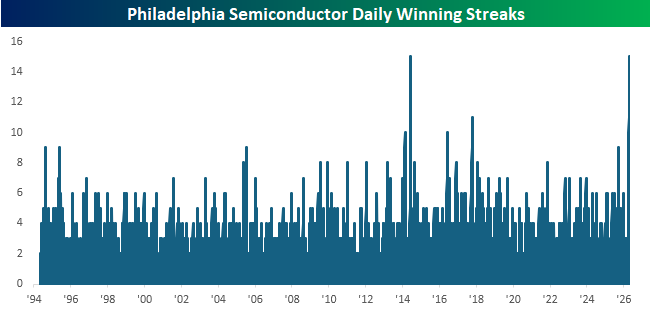
SOX Semiconductor Index Up 16th Straight Day
)..
1. SOX Semiconductor Index Up 16th Straight Day
Semiconductors continued to roll yesterday as the Philadelphia Semiconductor Index (SOX) traded higher for the 15th straight day, tying the record from June 2014. Besides these two periods, there have only been three other periods where the SOX even had a ten-day winning streak.
Bespoke Investments
..
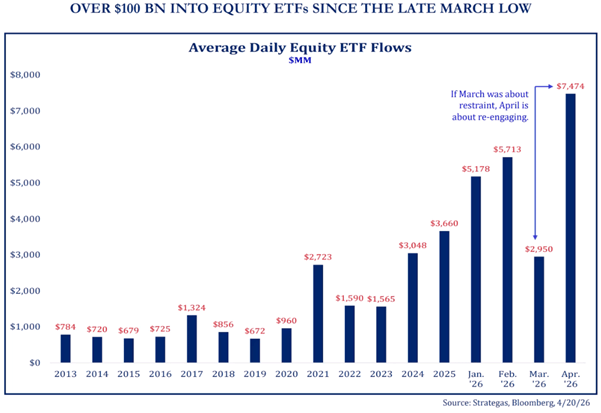
2. Over $100B into Stock ETFs Since Late March Low
Equity ETF flows. "If March ... was about restraint, April thus far has been more about re-engagement ... on one hand, it's a torrid pace. On the other, the sentiment backdrop, because of March's washout, is actually still supportive today."
..
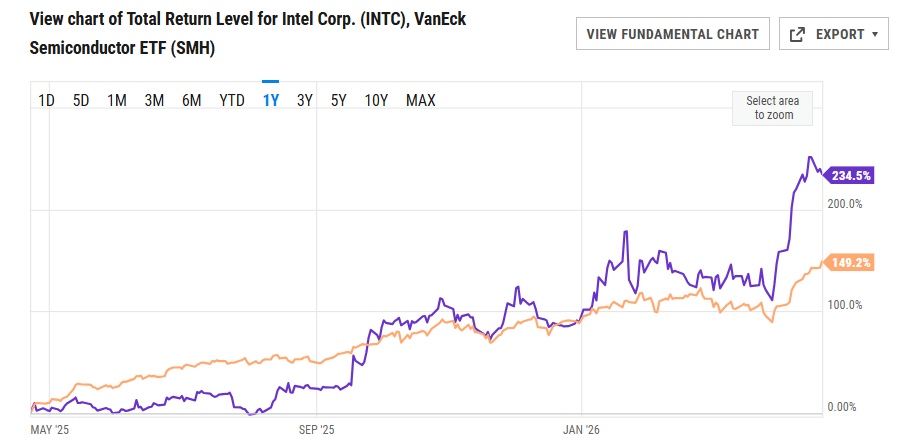
3. Intel Stock vs. Semiconductor ETF (SMH) One-Year Chart….INTC +234% vs. SMH +149%
Y-Charts
..
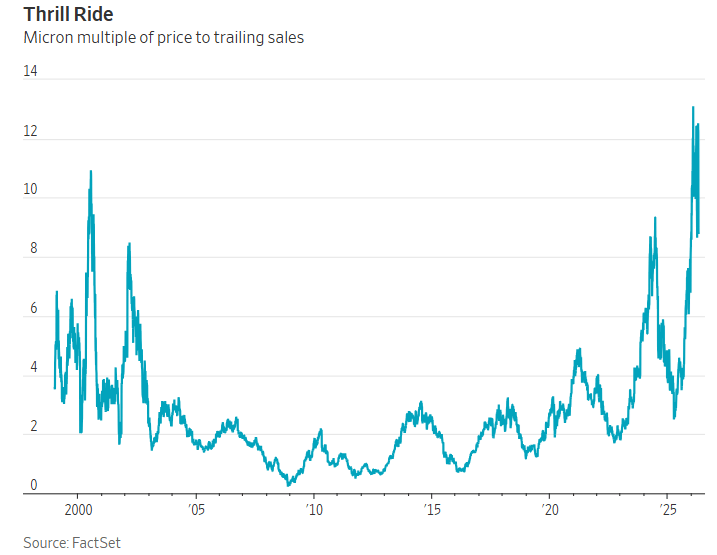
4. MU Micron Price/Sales was Sideways for 2x for Over a Decade…Then AI Hit
WSJ
..
5. Taiwan Market Cap Passing UK—AI
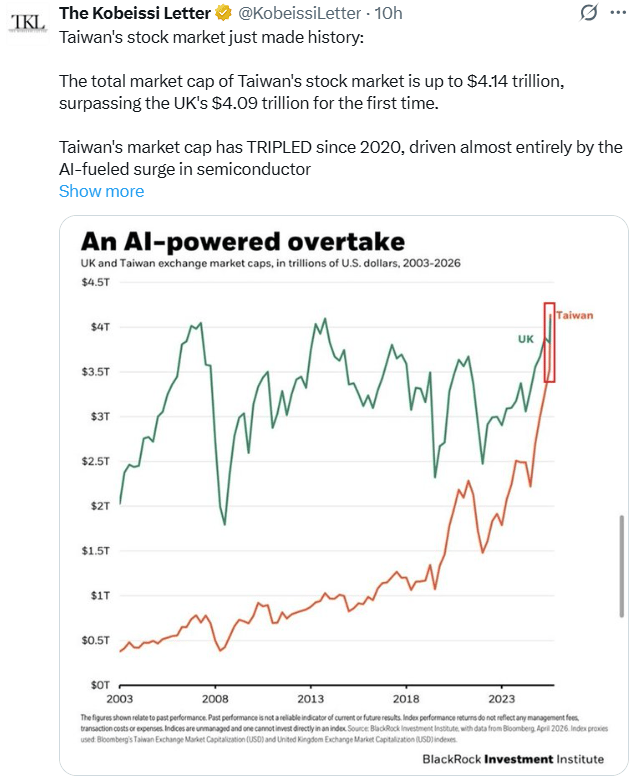
Kobeissi Letter
.
6. Three Asset Managers Own 22% of Everything

Lance Roberts
.
7. Google says 75% of the company's new code is AI-generated-BI
Google CEO Sundar Pichai and DeepMind CEO Demis Hassabis. By Hugh Langley
Three-quarters of new code at Google is being generated by AI, the company said.
The number has been steadily increasing as the company pushes staff to adopt AI tools.
Google CEO Sundar Pichai said a recent code migration was done six times faster thanks to AI agents.
How does AI improve code migration?
Why is Google pushing AI adoption?
What is Claude Code by Anthropic?
What are "agentic workflows"?
How do engineers review AI-generated code?
Three-quarters of new code created inside Google is now generated by AI and reviewed by human engineers, the company said Wednesday.
That number has been notching up in recent years. As of October 2024, around a quarter of the company's code was AI-generated, Google said at the time. Last fall, it said the number had risen to 50%.
The company has been pushing employees to use AI both for coding and other tasks. Google CEO Sundar Pichai said in a blog post on Wednesday that the company was shifting to "truly agentic workflows" with its engineers running more autonomous tasks "Recently, a particularly complex code migration done by agents and engineers working together was completed six times faster than was possible a year ago with engineers alone," Pichai said.
Google's engineers are using its Gemini models for generating code, and some have been set specific AI goals that will be factored into performance reviews this year.
.
8. Negative Art Returns Since 2021-Barrons

Barrons
….
9. American Applications for Irish Citizenship Jump 63%

Financial Times
..
10. Why High Achievers Can Feel Lost After Success
High achievers expect fulfillment at the finish line—but it fades. Elizabeth Mateer Ph.D.
Key points
Goals create structure, but the pursuit can feel better than the outcome.
Achievement can become identity, tying self-worth to performance.
Success fades quickly as the brain returns to baseline.
Emptiness can reveal what ambition alone can’t provide.
You work toward something for months (sometimes years), believing that when you finally arrive, you’ll feel different: calmer, happier, more certain. Maybe it’s earning the degree, getting the promotion, publishing the book, or reaching a long-awaited milestone. When that moment comes, you feel relief, pride, and exhilaration. But for many high achievers, that feeling fades fast and is replaced by restlessness and emptiness.
You think to yourself: Why doesn’t this feel the way I thought it would?
This feels confusing and even shameful when you’ve spent so long believing that achievement would bring the sense of fulfillment you’ve been chasing. But this reaction is far more common than most people realize.
Ambition itself isn't causing this feeling, but it might be a sign to pay attention to what ambition leaves behind.
Achievement Gives the Brain Structure
Working toward a clear outcome organizes your time, attention, and emotional energy. There’s a plan, a timeline, and a sense of forward motion. All help reduce uncertainty, which the brain naturally tries to avoid. The pursuit of goals also activates the brain’s reward system. Research in neuroscience underscores how dopamine surges peak during goal-seeking behaviors, which fuel motivation, focus, and momentum. But it tapers off once the goal is achieved, meaning the brain is literally designed to make the pursuit feel better than the arrival.
For some high achievers, that pursuit becomes a way of regulating stress, avoiding difficult emotions, or creating a sense of control. This is part of what makes the emotional letdown after success so surprising: sometimes, what we miss most isn’t the outcome itself, but the structure the striving gave us.
Achievement Often Becomes Identity
For many high achievers, accomplishment doesn’t just reflect what they’ve done, it becomes intertwined with who they believe they are. Over time, productivity, ambition, and success can start to feel less like choices and more like proof: I am capable. I am valuable. I matter because I perform. This dynamic is especially common in people who are naturally driven, perfectionistic, or who grew up in environments where praise, love, or a sense of safety felt closely tied to achievement. In these cases, striving can become a way of managing self-worth.
Research from Self-Determination Theory (SDT) distinguishes between intrinsic goals (e.g., personal growth and meaningful relationships) and extrinsic goals (e.g., financial success, status, or appearance). While both can motivate behavior, extrinsic goals are more consistently associated with lower well-being, particularly when they come to dominate a person’s sense of identity. The issue isn’t ambition itself, but whether the goals we pursue actually meet core psychological needs: autonomy (a sense of choice and alignment), competence (feeling effective), and relatedness (feeling connected to others). When achievement is pursued primarily as external validation, these needs can remain unmet even in the face of objective success.
The Arrival Fallacy
Psychologists sometimes refer to this as the “arrival fallacy,” the mistaken belief that reaching a future milestone will finally bring lasting happiness, confidence, or peace. While achievement can absolutely bring pride and satisfaction, the emotional boost is often more limited and temporary. In a landmark study on hedonic adaptation, Brickman and colleagues compared lottery winners, individuals who had experienced severe accidents, and a control group. While their life circumstances differed dramatically, their reported happiness levels began to return to baseline over time. This study revealed that people both to positive and negative change, gradually returning toward the familiar. For high achievers, this can feel particularly disorienting. The milestone that once held so much emotional weight quickly becomes part of the new normal, and the mind begins searching for the next target.
Why Emptiness Can Actually Be Useful
Rather than seeing this emptiness as a sign that something is wrong, it may be more useful to view it as information. Specifically, information about what ambition leaves behind when it’s done. The emotional dip that follows a major accomplishment can create a rare pause where the noise of striving quiets and allows honesty to surface.
Sometimes that’s grief: for time lost, for sacrifices made, or for parts of yourself that were set aside along the way. Sometimes it’s burnout masked by momentum. Sometimes it reveals how little space you’ve made for joy, rest, relationships, or forms of identity that were never tied to performance in the first place.
One of the most useful shifts in this moment is moving from urgency to curiosity.
The instinct is often to quickly fill the space: set a new goal and move on. But this can replicate the same pattern without ever examining it. A different approach is to pause and ask: Whose life have I been building? Does it actually reflect who I am?
This question doesn’t reject ambition; it shifts the focus from achievement as a way to prove worth toward achievement as an expression of values.
What Fulfillment Actually Requires
The answer is not to abandon ambition, but to build a life that isn’t entirely organized around it. Research on the Hedonic Adaptation Prevention (HAP) model offers a useful framework here. The HAP model identifies a set of activities that help sustain well-being over time, not by chasing bigger goals, but by changing how we experience our lives. These include engaging in hobbies, introducing variety into daily routines, practicing gratitude, and investing in meaningful relationships.
It's worth noting that none of these involve increasing ambition or setting higher external benchmarks. Instead, they work by slowing the brain’s tendency to adapt and by reinforcing the kinds of experiences that actually support contentment.
Therefore, fulfillment is less about what you achieve and more about how your life is structured around your internal needs and values. Autonomy, connection, and a sense of genuine engagement tend to matter more than any single milestone. As someone who has spent much of my life moving from one goal to the next, I’ve learned that achievement can be deeply meaningful, but it can also become a way of postponing harder questions about who you are when no one is watching. The most grounding parts of life, the parts that truly make success feel meaningful, happen in the spaces where nothing is being measured.
Achievement can and should be part of a meaningful life. But when success becomes the only place you know how to feel valuable, winning can feel strangely lonely.
Did someone forward this email to you? Get your own:
Disclosure
Indices that may be included herein are unmanaged indices and one cannot directly invest in an index. Index returns do not reflect the impact of any management fees, transaction costs or expenses. The index information included herein is for illustrative purposes only.
Material for market review represents an assessment of the market environment at a specific point in time and is not intended to be a forecast of future events, or a guarantee of future results.
Material compiled by Lansing Street Advisors is based on publicly available data at the time of compilation. Lansing Street Advisors makes no warranties or representation of any kind relating to the accuracy, completeness or timeliness of the data and shall not have liability for any damages of any kind relating to the use such data.
To the extent that content includes references to securities, those references do not constitute an offer or solicitation to buy, sell or hold such security as information is provided for educational purposes only. Articles should not be considered investment advice and the information contain within should not be relied upon in assessing whether or not to invest in any securities or asset classes mentioned. Articles have been prepared without regard to the individual financial circumstances and objectives of persons who receive it. Securities discussed may not be suitable for all investors. Please keep in mind that a company’s past financial performance, including the performance of its share price, does not guarantee future results.
Lansing Street Advisors is a registered investment adviser with the State of Pennsylvania.