- TOPLEY'S TOP 10
- Posts
- Topley's Top 10
Topley's Top 10
Tech Valuation Gap Kaput!
)..
1. Tech Valuation Gap Kaput!

Torsten Slok Apollo
..
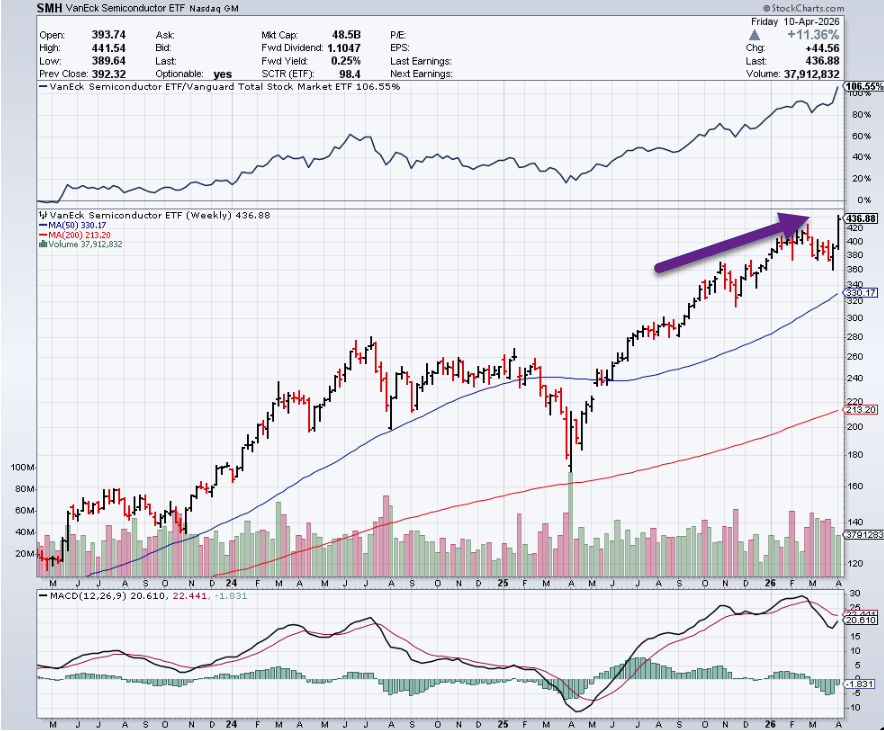
2. Huge Gaps in Tech Sub-Sector Performance...Semiconductor ETF Making All-Time Highs
Stock Charts
..
3. Technology Stock Insiders Buying
Tech insiders. "Technology sector insiders keep buying (The chart shows the total number of corporate insiders of companies covered by the XLK ETF that have bought shares on the open market during the past six months). Make of it what you will."

..
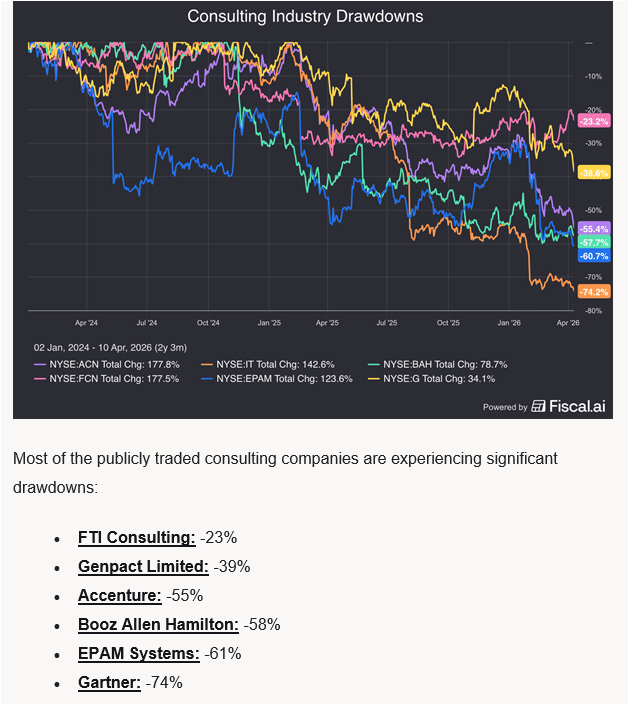
4. Consulting Stocks Slammed by AI
Fiscal.ai
..
5. Contra Indicator? Hedge Funds Max Bearish

Ryan Detrick
.
6. Google Search Shows the World is Focused on The Price of Oil

Kobeissi Letter
.
7. Real Rates Saying Lower 10-Year Rate Coming
It’s a good bet that interest rates will be lower in coming months — notwithstanding the ultimate resolution of the war in Iran, beyond the temporary cease-fire agreement, and the extraordinary volatility of energy prices to which the conflict has led.
That’s because U.S. Treasury real yields — reflecting the difference between nominal yields and inflation — are higher than at any time since the 2008 global financial crisis, as you can see from the chart below. More often than not historically, above-average real rates have been followed in fairly short order by lower nominal rates. By Mark Hulbert

Marketwatch
.
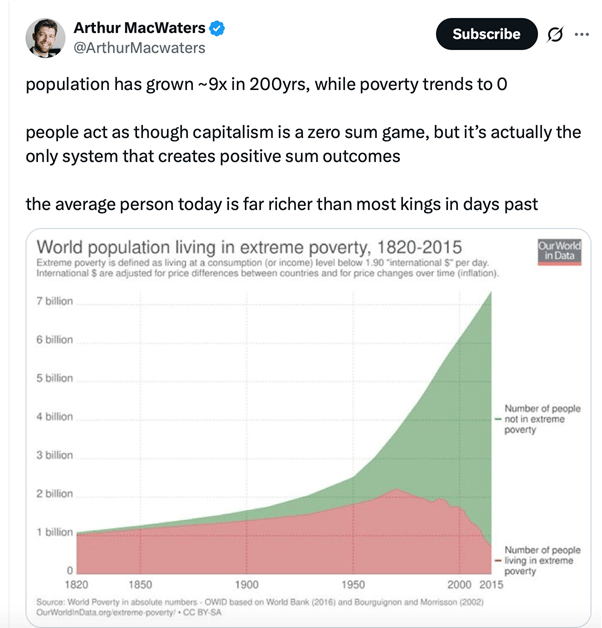
8. Population Growth Up 9X in 200 Years…Poverty Plummets
….
9. Eating the Same Meals Every Day Led to 37% More Weight Loss
Food variety is not the problem. A 12-week study suggests decision fatigue is the hidden variable in many failed diets. |
Today’s Health Upgrade |
The boring diet secret that actually works Weekly wisdom The problem with the scale |
Nutrition |
The Boring Diet Secret That Actually Works |
Most diet advice promises that if you just find the right foods, the right plan, and the right combination, it'll finally click. What gets less attention is that the choosing itself might be the problem. |
New research suggests the mental work of deciding what to eat every day and forcing variety undermines the effort people are already making. |
A 12-week study found that people who ate a more repetitive, predictable diet lost 37% more weight than those who varied their meals more frequently. And researchers believe reduced decision fatigue may be driving the difference. |
Researchers tracked overweight adults for 12 weeks in a structured behavioral weight-loss program, using real-time mobile food logs and daily weigh-ins. They measured two things: how much daily calorie intake fluctuated from day to day, and how often participants ate the same foods repeatedly. |
Variety can be a good thing. However, in a food environment engineered with high-calorie options at every turn, variety creates exposure, which can make it easier to stray from the intended plan. Each new choice is another moment when willpower has to show up, and willpower is a finite resource for many people who struggle with their weight. |
A predictable rotation of go-to meals can help sidestep that problem because the decision is already made. |
This isn't an argument against eating a wide variety of fruits, vegetables, and whole foods. Prior research consistently supports dietary diversity within healthy food groups. |
This study examines how much daily decision-making about eating can affect consistency. And because this was an observational study of people already in a structured program, the findings show an association, not a proven cause. |
The practical move is simpler than any diet plan: build a short rotation of meals you like, already know how to make, and can eat without negotiating with yourself. Four to six reliable options — breakfast, lunch, dinner — that you cycle through during the week. Not necessarily forever. Just enough to take the daily decision off the table. If you need help with a no-calorie-counting approach, try the Pump Club nutrition tracker. https://arnoldspumpclub.com |
..
10. Urgency Culture Is Impeding Our Ability to Live Well
It's time to learn the difference between urgent and important.-Psychology Today Ira Bedzow Ph.D.
KEY POINTS
We confuse activity with progress, reacting quickly without thinking about where we're going.
Living well requires time to reflect, not just efficiency in responding.
If you don’t intentionally choose your priorities, your sense of urgency will choose them for you.
Our lives are increasingly getting faster and faster. A text message arrives; we feel compelled to respond immediately. An email appears, and we interrupt whatever we were doing to acknowledge it. We don’t even notice that the person we were talking to kept on speaking. We look at our phones and forget whatever else we were doing or where we were going. Like hamsters in a lab hitting a bar, we keep moving faster and faster to get our dopaminehit, mistaking activity for progress and urgency for importance.
Notifications buzz, calendars fill, deadlines approach. We move from task to task without looking at the bigger picture. Forget the trees, we don’t see the forest through all the paper-pushing. If something is asking for our attentionright now, we believe it must deserve it.
But urgency and importance are not the same thing.
Urgent vs. Important
Urgent matters demand immediate action. Important matters shape how we live our lives. The problem is that urgent matters are almost always easier to address. They arrive clearly defined and time-bound" Answer this message, attend this meeting, meet this deadline. Once completed, they give us the satisfying feeling of progress.
Important matters are rarely that clearly defined, and, when addressed, they rarely give us a sense of making progress. Instead, they oftentimes give us a sense of needing to change direction. They may even overwhelm us if we are afraid to make that change.
Of course, there are issues that are urgent and important. If you don’t seek medical care for a serious and acute health concern, you may suffer significant long-term consequences. It is also totally understandable to drop everything to address family or other emergencies. These, however, are outliers, not the norm.
More often, decisions about how we take care of our health, develop strong relationships, or advance in our careers unfold slowly. They require reflection rather than reaction. Questions in these areas don’t demand immediate answers, but you do have to answer them, since they profoundly influence how you will live your life. Choosing how to spend our time, who to spend it with, and what kinds of work we engage in are among the most consequential decisions we make, but they never have the urgency as those things that pop up in our inbox or show up on our calendars.
When we respond to immediate cues rather than consider distant consequences, we gradually shift our attention away from what matters most. We become adept at managing the urgent while postponing—or forgetting about—what’s important. The result is that we may move faster and faster, but in reality we end up going nowhere or not knowing where we are going.
Life Grooves
Over time, the patterns we create through reacting rather than reflecting solidify into what I like to call “life grooves.” The more deeply those grooves form, the harder they are to step out of. Opportunities that once felt available may no longer seem feasible. Paths that once felt optional may start to feel inevitable.
In this way, urgency culture can quietly limit our freedom. It doesn’t mean that stepping out of a life groove is impossible. It just means that we need to be much more intentional and work that much harder to change the path our habits have set for us.
Living well requires more than efficiently responding to external demands. It involves choosing actions and cultivating habits that reflect the kind of person you want to become. But reflection takes time, and urgency rarely makes space for it. So, one of the first steps to living well is choosing to give yourself the time to make good choices.
This does not imply that urgent and important matters should be ignored. Deadlines matter. Responsibilities matter. But treating every immediate demand as equally significant risks crowding out the activities and relationships that contribute most to a meaningful life.
We need to find ways to resist this pressure, to create space for reflection even when no crisis demands it. This might include scheduling regular time to think rather than to do, taking a pause between receiving a request and responding to it, or setting aside device-free moments at certain points of the day or week to allow you to connect to other things.
If you are someone who wants to work on creating healthy boundaries, practicing the intentional “No” can protect time for relationships, recreation, health, or meaningful work. Planning for important but non-urgent matters—such as exercise, maintaining connections, or investing in your own professional growth—ensures that these priorities are addressed before they slip away or are imposed upon us by circumstance.
The question of how to spend a single afternoon may seem trivial, but the pattern of how we spend our afternoons shapes who we become. Not everything urgent is important, and the challenge is recognizing the difference before our habits create a life for us that we would rather not have.
Did someone forward this email to you? Get your own:
Disclosure
Indices that may be included herein are unmanaged indices and one cannot directly invest in an index. Index returns do not reflect the impact of any management fees, transaction costs or expenses. The index information included herein is for illustrative purposes only.
Material for market review represents an assessment of the market environment at a specific point in time and is not intended to be a forecast of future events, or a guarantee of future results.
Material compiled by Lansing Street Advisors is based on publicly available data at the time of compilation. Lansing Street Advisors makes no warranties or representation of any kind relating to the accuracy, completeness or timeliness of the data and shall not have liability for any damages of any kind relating to the use such data.
To the extent that content includes references to securities, those references do not constitute an offer or solicitation to buy, sell or hold such security as information is provided for educational purposes only. Articles should not be considered investment advice and the information contain within should not be relied upon in assessing whether or not to invest in any securities or asset classes mentioned. Articles have been prepared without regard to the individual financial circumstances and objectives of persons who receive it. Securities discussed may not be suitable for all investors. Please keep in mind that a company’s past financial performance, including the performance of its share price, does not guarantee future results.
Lansing Street Advisors is a registered investment adviser with the State of Pennsylvania.