- TOPLEY'S TOP 10
- Posts
- Topley's Top 10
Topley's Top 10
U.S. Inflation by Decade
..
1. U.S. Inflation by Decade

Ben Carlsom
..
2. Wage Growth vs. Inflation
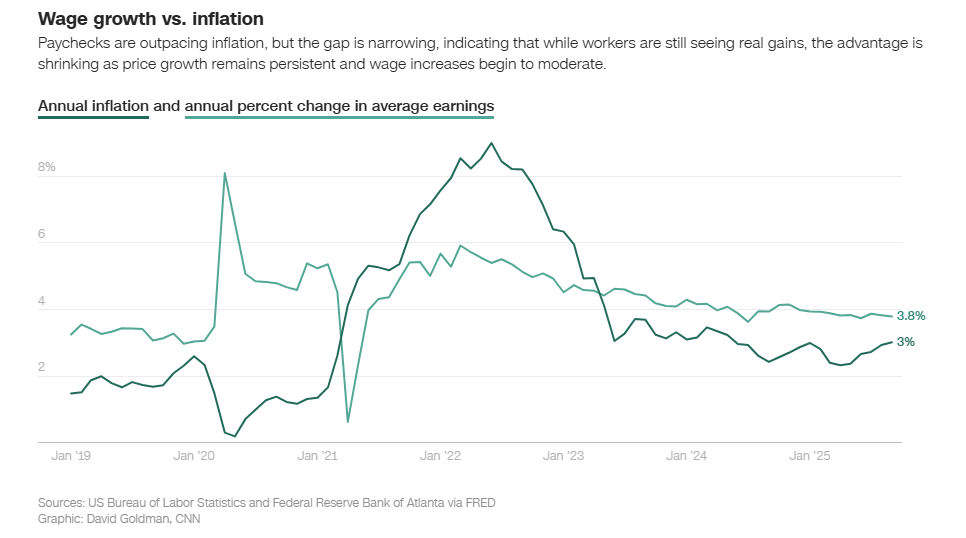
CNN
..
3. Dow Transports About to Break Out…This is Not a Sign of Slowing Economy

Stock Charts
…
4. Micro-Cap Stocks Outperforming S&P in 2025

Google Finance
..
5. Microcaps and Transports Above Part of Rotation in Flows Happening Now
Rotation. "Flows are rotating into undervalued cyclicals, small-capitalization stocks and economically sensitive segments of the market as traders position to benefit from the anticipated boost in economic growth next year."

Alexandra Semenova - Bloomberg via Daily Chart Book
.
6. Like CSCO….QCOM 20-Years for Stock to Get Back Above 1999 Highs

.
7. Large Companies Lead AI Adoption
At the corporate level, companies have also been keen to experiment with AI, hoping the tech could help them automate processes or unlock efficiencies. Surveys from the US Census Bureau have shown that commercial adoption of AI has been gently rising, with larger firms (those with over 250 employees) more likely to say they have used AI in a business function than smaller firms.

Failing real progress, “performative AI usage” has also become pretty common in the working world. For starters, public company execs can’t stop talking about it, hoping investors will re-evaluate their stocks, having seen the prices of AI darlings at the center of the boom — names like Nvidia, Alphabet, Broadcom, Palantir, and CoreWeave — take off.
Even boring old power companies are now sexy, with many analysts now of the belief that electricity supply is the most pressing bottleneck for the AI ecosystem. Things that used to just be called “software” are now “AI-powered,” and a new crop of opportunistic entrepreneurs are eschewing nearly all other ideas to build in the AI arena. www.chartr.com
At the corporate level, companies have also been keen to experiment with AI, hoping the tech could help them automate processes or unlock efficiencies. Surveys from the US Census Bureau have shown that commercial adoption of AI has been gently rising, with larger firms (those with over 250 employees) more likely to say they have used AI in a business function than smaller firms.
Failing real progress, “performative AI usage” has also become pretty common in the working world. For starters, public company execs can’t stop talking about it, hoping investors will re-evaluate their stocks, having seen the prices of AI darlings at the center of the boom — names like Nvidia, Alphabet, Broadcom, Palantir, and CoreWeave — take off.
Even boring old power companies are now sexy, with many analysts now of the belief that electricity supply is the most pressing bottleneck for the AI ecosystem. Things that used to just be called “software” are now “AI-powered,” and a new crop of opportunistic entrepreneurs are eschewing nearly all other ideas to build in the AI arena. www.chartr.com
.
8. The Number of American Families with Children Under 18 Peaked in 2007
US Demographics Are Changing
Although the US population continues to grow each year, the number of families with children under 18 reached a peak of around 37 million in 2007 and has declined to approximately 33 million in 2024, see chart below. This reflects demographic changes such as lower birth rates and aging of the population, even as overall population growth continues.

Sources: US Census Bureau, Apollo Chief Economist
.
9. Huge Spike in Gambling Problem Hotlines
GETTING HELP– Two charts are going up and to the right at the same time: States are raking in tax revenue from sports betting and online casinos, and calls to the National Problem Gambling Helpline are on the rise. The data points to a troubling trend — America’s gambling boom is driving more people into financial and emotional distress, with young men at the epicenter. But the industry continues to expand at breakneck speed, powered by aggressive marketing, state budget incentives and AI.

Dave Lutz Jones Trading
AI is poised to supercharge the gambling industry, says Tech policy experts. The technology can help sportsbooks fine-tune their odds — making them even less likely to lose. It can also figure out when users are most likely to place bigger or riskier bets, pinpoint who's prone to making bad ones and target them with ads at their most vulnerable moments.
.
10. Neuroscience Just Showed How 1 Type of Activity Stops Your Brain From Aging
You might think it’s just a hobby. It’s also a powerful tool for brain health.
EXPERT OPINION BY MINDA ZETLIN, AUTHOR OF 'CAREER SELF-CARE: FIND YOUR HAPPINESS, SUCCESS, AND FULFILLMENT AT WORK' @MINDAZETLIN
How can you keep your brain agile and young throughout your life, even as you get older? By spending time on creative pursuits as often as you can. That’s the fascinating finding of a study by researchers from Universidad Adolfo Ibañez in Chile and Trinity College in Ireland, among others.
As the study’s authors note, earlier studies have shown a connection between creative activities such as playing a musical instrument and improved brain health. They wanted to know just how creativity affects brain health. So they first recruited more than 1,200 healthy people as controls, and then compared them to 1,467 research participants who spent at least some of their time in creative pursuits. This included dancers, musicians, visual artists, and strategy-based gamers. (Real-time strategy-based games are complex and involve creativity.)
Using EEG readings, they determined each participant’s “brain age gap,” the difference between their chronological age and the apparent age of the participant’s brain. What they found was that creative people across all disciplines had younger brains than their non-creative peers. Dancers had some of the youngest brains compared to their actual ages. This isn’t surprising since previous research has consistently shown that strenuous physical activity also slows brain aging. This means that dancing, which is physically strenuous as well as creative packs a double dose of brain health. Strategic gamers had the smallest brain age gap, though they still saw benefits.
The researchers also discovered that those who were most expert in their respective creative areas saw the greatest brain benefit. And they found that connections within the brain that typically deteriorate with aging were stronger in these creative types.
“We tend to treat creativity as a luxury.”
What does all this mean to you? If your current work involves a lot of creativity, that’s good news. Chances are it’s benefiting your brain and helping you stay mentally young. But whether your work is creative in itself or not, it also means that you should make time in your week for your own creative activities. “We tend to treat creativity as a luxury after the ‘real work’ is done,” writes Karen E. Todd, a registered dietician who writes the Feed Your Brain blog for Psychology Today. Instead, she writes, we should prioritize our creative practices the same way we prioritize sleep, because both are essential for keeping our brains young.
Even 10 minutes of creative activity can make a difference if you do it every day, she writes. And, as the study shows, the more time you spend on it, and the more expert you become, the greater that benefit will be.
So pick up a paintbrush, guitar, camera, or notebook. Dive into a complex creativity-boosting game either online or in real life. Or put on your dancing shoes and sign up for tango lessons. Whatever you choose, make sure it’s something you enjoy, so that you are happy to make time for it and stick with it. Your brain will be happy you did.
There’s a growing audience of Inc.com readers who receive a daily text from me with a self-care or motivational micro-challenge or tip. Often, they text me back and we wind up in a conversation. (Want to know more? Here’s some information about the texts and a special invitation to a two-month free trial.) Many of my subscribers are entrepreneurs or business leaders. They know how important it is for all of us to keep our brains as young as possible throughout our lives. Getting creative can be a fun way to do that. Should you give it a try?
.
Did someone forward this email to you? Get your own:
Disclosure
Indices that may be included herein are unmanaged indices and one cannot directly invest in an index. Index returns do not reflect the impact of any management fees, transaction costs or expenses. The index information included herein is for illustrative purposes only.
Material for market review represents an assessment of the market environment at a specific point in time and is not intended to be a forecast of future events, or a guarantee of future results.
Material compiled by Lansing Street Advisors is based on publicly available data at the time of compilation. Lansing Street Advisors makes no warranties or representation of any kind relating to the accuracy, completeness or timeliness of the data and shall not have liability for any damages of any kind relating to the use such data.
To the extent that content includes references to securities, those references do not constitute an offer or solicitation to buy, sell or hold such security as information is provided for educational purposes only. Articles should not be considered investment advice and the information contain within should not be relied upon in assessing whether or not to invest in any securities or asset classes mentioned. Articles have been prepared without regard to the individual financial circumstances and objectives of persons who receive it. Securities discussed may not be suitable for all investors. Please keep in mind that a company’s past financial performance, including the performance of its share price, does not guarantee future results.
Lansing Street Advisors is a registered investment adviser with the State of Pennsylvania.