- TOPLEY'S TOP 10
- Posts
- Topley's Top 10
Topley's Top 10
S&P Valuation Below 20x Forward P/E Still Well Above Median and Liberation Day Levels
)..
1. S&P Valuation Below 20x Forward P/E Still Well Above Median and Liberation Day Levels
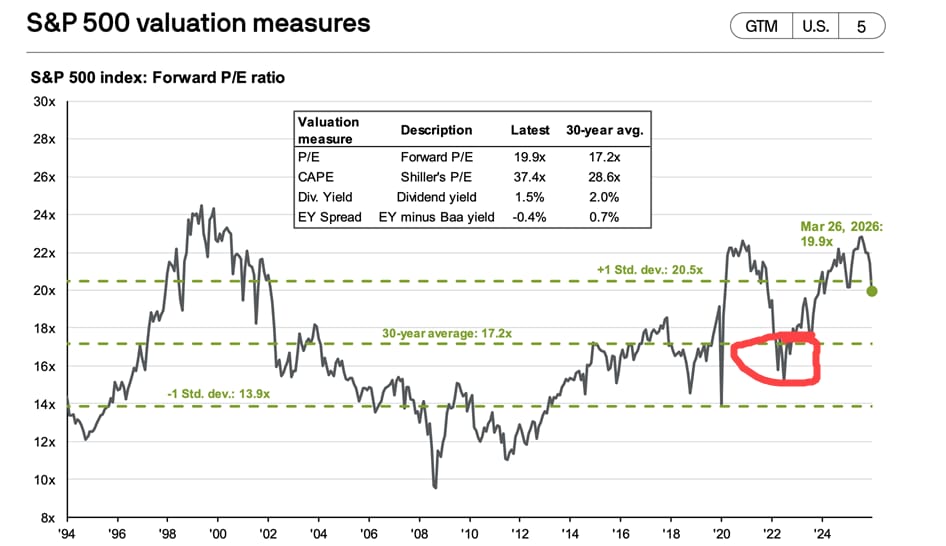
JP Morgan Asset Management
..
2. ACWI Global Stock Index 12 month and 24 month Forward P/E Lower
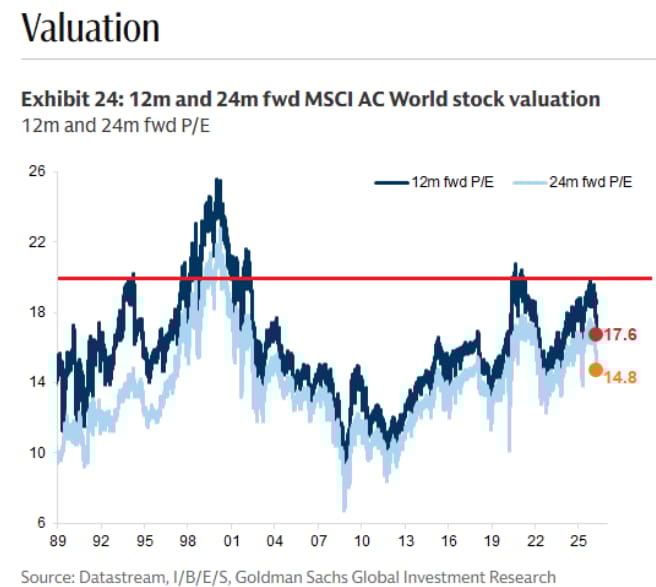
..
3. Seasonality for Q2 Presidential Cycle
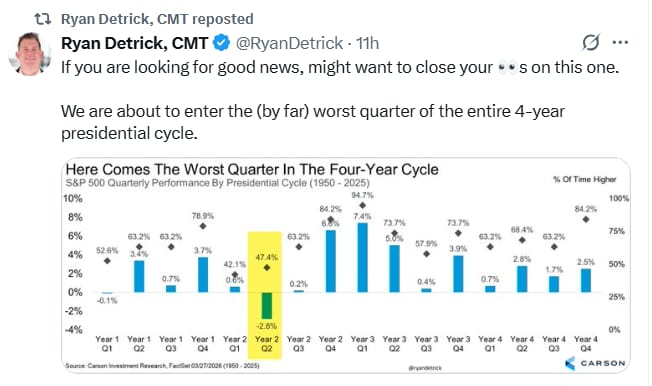
Ryan Detrick
..
4. 30-Year Treasury Close to 5%...Close to Highest Level Since GFC
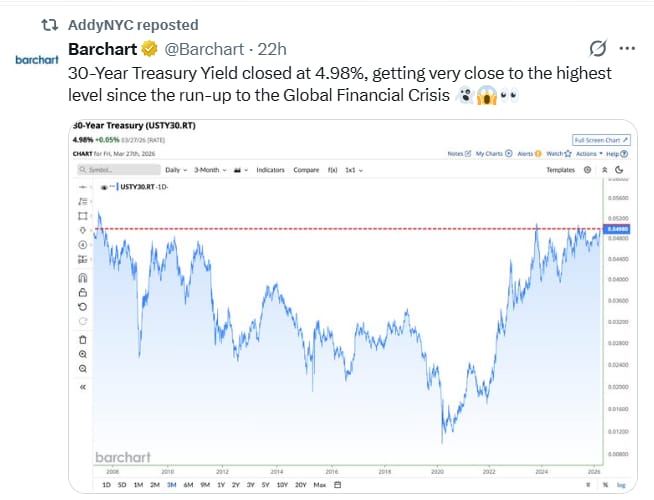
Barchart
..
5. INDA India Stock Market Now Down on One-Year Basis
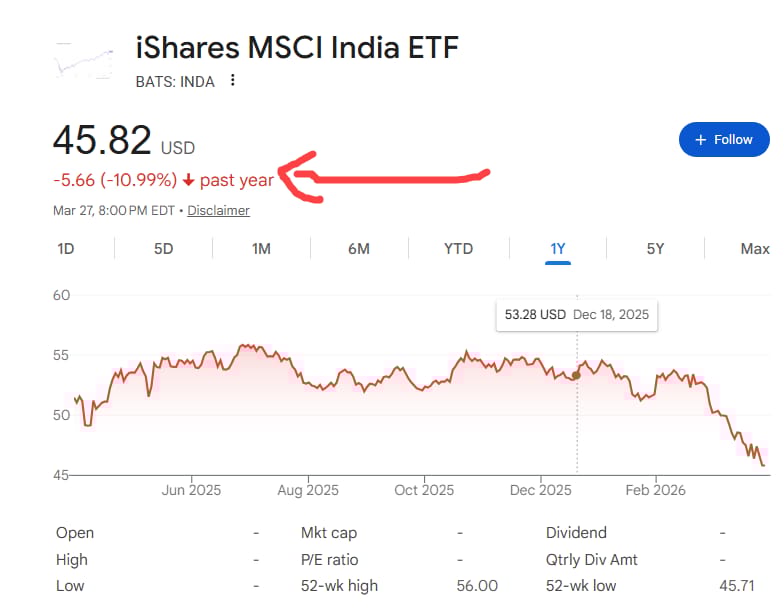
Google Finance
.
6. Trump Approval Rating Suffering
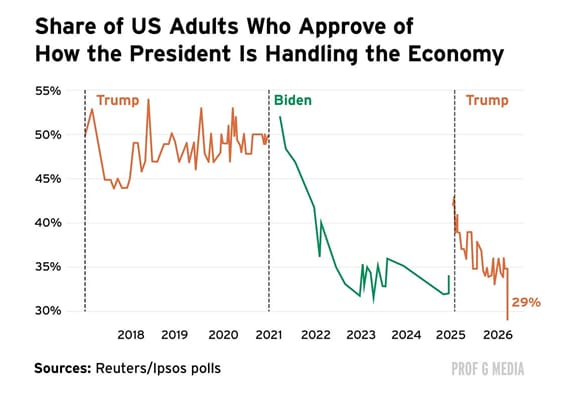
Prof G Media
.
7. Trump Media Stock DJT -37% 2026…Breaks to New Lows
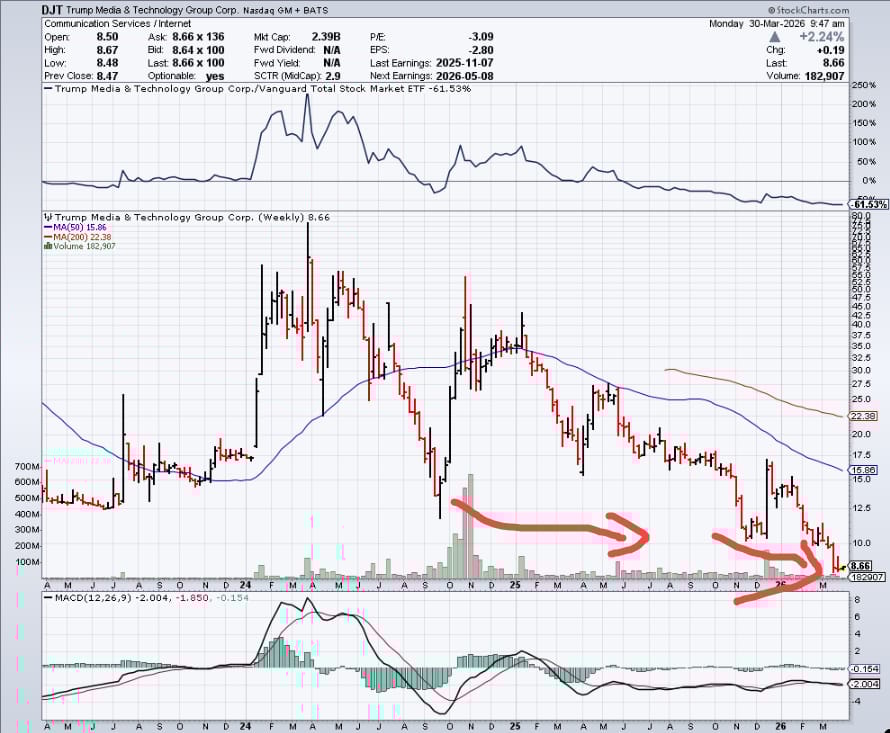
StockCharts
.
8. Waymo 500k Trips Per Week
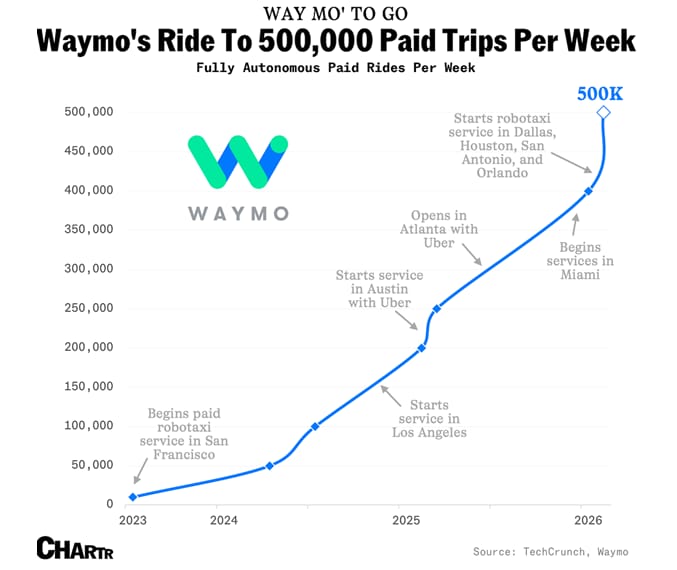
chartr
….
9. Fidel Castro Wealthy Parents

Perplexity
..
10. Your Brain on Nature: What Neuroscience Tells Us About Mental Performance and the Outdoors
By SUCCESS Staff March 27, 20268 min read
You’ve probably dismissed the afternoon walk more times than you can count.
There’s a deadline. There’s a meeting. There’s a message that needs answering. The idea of stepping outside for 20 minutes feels indulgent at best, irresponsible at worst—like something you’ll reward yourself with once the work is done.
Here’s the thing: The neuroscience says you have it exactly backward.
Spending time in natural environments isn’t a break from high performance. According to a growing and increasingly rigorous body of research, it’s one of the most direct routes to it. This isn’t wellness advice dressed up in productivity language. This is brain imaging data, randomized controlled trials and cortisol measurements—pointing to the same conclusion. Your brain on nature performs measurably better than your brain without it.
Here’s what the research actually shows—and how to use it.
Science Has Finally Caught Up to What You Already Suspected
For years, the benefits of being outdoors were treated as anecdotal—a feeling, not a fact. That’s no longer a defensible position.
A comprehensive scoping review published in Neuroscience & Biobehavioral Reviews in early 2026 synthesized neuroimaging findings from EEG, fMRI and structural MRI studies conducted across real-world settings, controlled labs and even virtual environments. Across all these settings, exposure to natural stimuli was reliably associated with acute reductions in activity within stress-related and self-referential brain circuits, shifts toward brain states consistent with attentional restoration and longer-term structural advantages in cognition.
Read that carefully. This isn’t self-reported relaxation. This is measurable neurological change—visible on brain scans—from exposure to nature.
The review goes further, noting that natural environments may function as “spontaneous regulators” of the nervous system, passively guiding the brain toward states that are otherwise cultivated through intentional contemplative practice—states that most high-performers spend significant time and money trying to replicate through meditation apps, breathwork and recovery protocols.
Nature, it turns out, may do it for free.
Why Your Brain Needs a Different Kind of Input
To understand why the outdoors restores mental performance, you need to understand what depletes it in the first place.
Modern work environments are relentlessly demanding on a specific cognitive resource: directed attention. Every email, notification, decision and open browser tab requires your prefrontal cortex to actively filter, prioritize and select. This is effortful work—and like any resource, it has a limit.
Attention restoration theory, developed by researcher Stephen Kaplan, proposes that natural environments restore this capacity because they engage attention in a fundamentally different way. Natural settings are engaging to look at, but in a way that does not place much demand on executive attention resources—allowing the directed attention system to rest and recover.
The analogy that holds up: Your directed attention is like a muscle. Working in a screen-saturated environment flexes it continuously, without recovery. Nature gives it something to engage with that doesn’t require effort—and that difference is measurable at the neural level.
What Happens to Your Brain on a Nature Walk
A 2024 randomized controlled trial published in Scientific Reports put this directly to the test with 92 participants, comparing a 40-minute nature walk against an urban walk of identical time, distance, pace and physical exertion.
While positive affect improved for both groups, nature walkers showed a significantly greater boost in mood than urban walkers. EEG data revealed greater frontal midline theta activity following the urban walk compared to the nature walk, suggesting the urban walk placed higher demands on executive attention, while the nature walk left those resources intact and available.
The practical implication is significant. When you return from a city walk—navigating traffic, pedestrians, noise—your attention system has been working the whole time. If you return from a park walk, it has been quietly recovering. The same amount of time produces meaningfully different cognitive states.
But it doesn’t stop there.
The Stress Hormone Effect Is Measurable and Fast
Mental performance and stress physiology are inseparable. When cortisol—the primary stress hormone—is chronically elevated, it impairs memory consolidation, narrows creative thinking and degrades decision quality. Managing it isn’t optional for high performance; it’s foundational.
Nature exposure produces measurable cortisol reduction. A randomized controlled study published in Environment and Behavior found that walking in nature resulted in lower cortisol levels than either watching nature on screen or walking on a treadmill indoors—and the effect was strongest during periods of real-life stress.
More recently, a 2025 study published in Scientific Reports found that repeated forest walks produced lower cumulative hair cortisol concentrations—a marker of chronic rather than acute stress—alongside measurable improvements in emotional well-being. This matters specifically for leaders and professionals carrying sustained workloads: The benefit isn’t just a momentary reset. Regular outdoor exposure appears to shift the baseline.
The key is to understand this as a performance input, not a mood enhancement. Lower cortisol means sharper recall, wider thinking and better judgment—the exact cognitive outputs that drive professional results.
Walking Outdoors Increases Creative Output
Here is one of the most practically useful findings in this entire body of research.
Stanford researchers Marily Oppezzo and Daniel Schwartz published a landmark study in the Journal of Experimental Psychology demonstrating that a person’s creative output increased by an average of 60% when walking compared to sitting, with the overwhelming majority of participants showing improved performance on divergent thinking tasks while in motion.
Divergent thinking—the ability to generate multiple novel ideas from a single prompt—is the cognitive mode most associated with problem-solving, strategic brainstorming and creative work. It’s exactly what gets compressed under pressure, after a string of back-to-back meetings or when you’ve been staring at the same problem for too long.
The researchers noted that the benefits of walking applied specifically to divergent thinking, but not to convergent thinking—the focused, analytical work that requires a single correct answer.
So what does this mean for you? Walking isn’t a substitute for deep focus work. It’s a tool for a specific cognitive mode—idea generation, reframing, strategic thinking—and it works best when deployed intentionally at the front end of that kind of work, not after it.
The Attention Restoration Effect Kicks In Faster Than You Think
One of the most common objections to building outdoor time into a workday is the assumption that meaningful restoration requires significant duration. The research does not support this.
A review examining short-term nature exposures ranging from 10 to 90 minutes found that in 12 out of 14 studies, cognitive benefits—specifically directed attention restoration from mental fatigue—merged across all educational levels following even brief contact with nature.
Twenty minutes is enough to move the needle on attentional capacity. Forty minutes is enough to produce measurable changes in brain activity. This is not a prescription for a two-hour retreat. It’s a case for a lunch break that actually restores something.
The accumulated evidence has practical implications for workplace architecture, urban planning and mental health interventions, suggesting that incorporating nature exposure into daily routines represents a scientifically grounded strategy for enhancing resilience, reducing stress and supporting cognitive performance.
How to Build This Into Your Real Schedule
The research is consistent enough to act on. Here’s a practical framework that doesn’t require overhauling your calendar.
Use the walk as a premeeting cognitive primer. The creativity data shows a residual boost that persists after walking ends. A 15-to-20-minute outdoor walk before a strategy session, a difficult conversation or a brainstorming block loads your brain with exactly the cognitive resource that work will draw on.
Treat outdoor breaks as attentional recovery, not time off. Reframe the narrative. You are not stepping away from work; you are recovering the directed attention capacity that makes work productive. A 20-minute park walk midafternoon is an investment in the quality of the three hours that follow.
Prioritize green space over built environments when you can. The research consistently shows that natural settings outperform urban settings for cortisol reduction and attentional restoration, even when physical exertion is the same. Your commute walk doesn’t count in the same way, so seek out a park, a trail or even a tree-lined street.
Go without your phone when the goal is restoration. Checking messages during an outdoor walk reactivates the directed attention demands you’re trying to recover from. It defeats the mechanism. For the walk to function as a cognitive reset, give your prefrontal cortex permishttps://www.success.com/brain-on-nature-mental-performance-outdoorssion to disengage from inputs entirely.
..
Did someone forward this email to you? Get your own:
Disclosure
Indices that may be included herein are unmanaged indices and one cannot directly invest in an index. Index returns do not reflect the impact of any management fees, transaction costs or expenses. The index information included herein is for illustrative purposes only.
Material for market review represents an assessment of the market environment at a specific point in time and is not intended to be a forecast of future events, or a guarantee of future results.
Material compiled by Lansing Street Advisors is based on publicly available data at the time of compilation. Lansing Street Advisors makes no warranties or representation of any kind relating to the accuracy, completeness or timeliness of the data and shall not have liability for any damages of any kind relating to the use such data.
To the extent that content includes references to securities, those references do not constitute an offer or solicitation to buy, sell or hold such security as information is provided for educational purposes only. Articles should not be considered investment advice and the information contain within should not be relied upon in assessing whether or not to invest in any securities or asset classes mentioned. Articles have been prepared without regard to the individual financial circumstances and objectives of persons who receive it. Securities discussed may not be suitable for all investors. Please keep in mind that a company’s past financial performance, including the performance of its share price, does not guarantee future results.
Lansing Street Advisors is a registered investment adviser with the State of Pennsylvania.